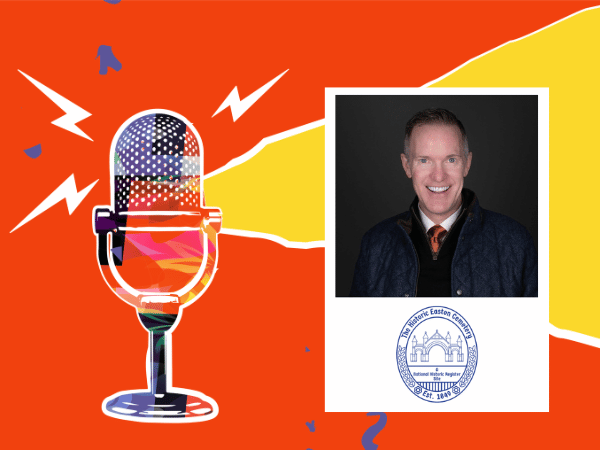
Keith Lampman-Perlman once took the lowest-paying job of his career to spend his days organizing wheelchair parties at a nursing home on Cape Cod.
He loved it.
After just a few months, HR discovered his decades of executive experience at national brain tumor organizations and hospital systems and promoted him to general manager.
But Keith never forgot what that year taught him: the best fundraisers show up when people need them most.
Today, at nearly 60 years old, Keith leads fundraising for the Historic Eastern Cemetery in Pennsylvania's Lehigh Valley, where he's raising funds to restore Victorian monuments and preserve 175 years of history.
"I feel as though I've landed at a place where I can bring my strengths and my talents," he says. "Some people say that I have expertise in creating awareness and community impact. And what that all leads to is funding streams for a place like this historic cemetery."
The Path That Found Him
Keith started as a banker in his hometown of Catskill, New York. He thrived there and stayed nearly 14 years, until a hospital president asked him to become their executive director.
Keith thought he'd do that for six months, maybe a little longer.
He stayed eight years.
Hospital work revealed something banking never had: he loved helping organizations build capacity to serve people through their most vulnerable moments.
"That's how I like to live my life," he says. "Helping people help themselves."
And when a board member who'd lost a child to a brain tumor recommended Keith for a role at the National Brain Tumor Society, he jumped at the opportunity.
"I thought I was all that back then, in my early 30s," he laughs. "I was going to go national and share my experience."
Keith helped create national fundraising events for brain tumor research. He also attended far too many funerals, particularly for children.
"There's nothing more unnatural for a parent than to lose a child," he says quietly. "Those are the most difficult funerals to go to, to suffer with the family."
Those experiences taught Keith something essential about fundraising: grief clarifies what matters. People don't give to organizations with impressive credentials. They give because they've felt pain and want to prevent others from experiencing it.
The Value of Showing Up
Keith admits he sometimes has to talk himself into attending another gala when he'd rather be home in his pajamas watching TV.
But he goes. And not just to fancy events.
"Talk is cheap," he says. "If I get up, get dressed, get in my car, and drive to somebody's house and say, 'What's going on with you?' That matters."
This philosophy shapes his work at the cemetery, too. Last winter, a heavy snowstorm forced Keith to close the vehicle gates for safety. But he kept the walking paths open for families who wanted to trek through the snow to visit loved ones.
When temperatures stayed dangerously low for days, he made the harder call and closed the cemetery entirely. He knew people would be disappointed. Some would be heartbroken. But showing up for people sometimes means making difficult decisions on their behalf, even when it's not what they want.
Keith has been making these kinds of decisions his entire career.
During COVID-19, when he managed a continuing care retirement community on Cape Cod, his facility didn't lose a single resident to the virus. Keith credits the medical staff's care, but also his strict implementation of protocols: mandatory masks, face shields, and gloves for everyone entering the facility.
Whether it's closing cemetery gates in a snowstorm or protecting nursing home residents during a pandemic, Keith's approach remains the same: show up, make the hard calls, and put people's well-being first.
The People Who Were Watching
Keith landed his latest role because someone had been watching him for two and a half years.
He didn't know it at the time. He was simply showing up and treating people well. But when the position opened, the person "put their fist on the table," as Keith tells it, and said, "We’re hiring you. You’re exactly what we need."
The key, he's learned, is being fully present with people. When Keith sits with someone, he gives them his complete attention. No checking phones. No glancing at watches.
"One of the greatest compliments I've received from people is that I pay attention to them," he says. "You really have to stay present."
That presence creates relationships that last far beyond his tenure at any single organization.
A Cemetery that Needs Fundraising
Most people don't think cemeteries need donors.
"The first thing that I found out was that most people don't realize that the Historic Eastern Cemetery is a nonprofit," Keith says. "We rely on donors to sustain ourselves."
The 175-year-old nonprofit needs $250,000 annually just for basic operations: mowing, maintaining 42,000 gravestones, repairing roads, and keeping the gates open.
Beyond maintenance, Keith is also raising funds to repair the Victorian-era mausoleum and historic chapel.
"We're a working cemetery," Keith explains. "It's as simple as making certain that every decision we make honors those that are interred here, and at the same time, create events and allow our space to be utilized for the community."
It's what he's learned throughout his career: connect people to the human impact their support creates. He's preserving a place where history, grief, and beauty intersect.
Where He Belongs
Every morning, Keith thinks about how he can be better than he was yesterday. And every evening, he reflects on what he'd do differently.
"I'm doing the best I can with the resources I have, with the knowledge I have, and with the experience I have," he says. "I'm doing my best to make anyone who comes in contact with me have a better life."
Because after nearly four decades in the nonprofit sector Keith has learned something essential: the closer you get to the human experience, the clearer it becomes why people give.
He could never have known he’d finish his career at a cemetery. But standing in the caretaker's cottage, he can see the thread.
"I think it's all related to the human experience and people," he reflects. "My love of helping people help themselves has led me here, and I dare say we end up where we belong."
For Keith, that's a 175-year-old cemetery where 42,000 stories are preserved, families grieve, and visitors find beauty.