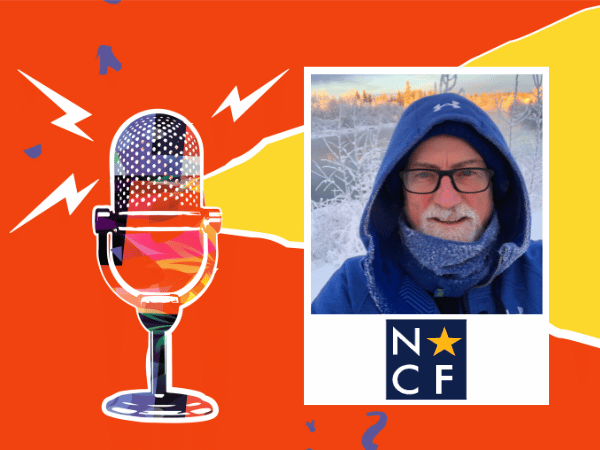
At 6:30 in the morning, Peter Pinney is already on a call, already thinking about who isn't at the table yet.
That instinct, to find the missing voice and pull them into the room, has driven three decades of community work in Fairbanks, Alaska. It's also what led him to join North Star Community Foundation, which now supports twenty member projects ranging from a book arts guild to a housing and homeless coalition.
He shows up on mornings when the headlines make most of us want to stay in bed.
Federal funding cuts. Economic uncertainty. A sector stretched thin and asked to do more with less. All of it.
Pinney knows that feeling. He'll tell you, with a laugh, that he's still fighting imposter syndrome after thirty years in the field. It's probably why his advice on perseverance, reframing the ask, and celebrating progress lands differently than most.
You're Not Begging, You're Inviting People to Help
Few things can drain nonprofit professionals faster than asking for money. The guilt. The fear of rejection. The creeping sense that you're inconveniencing people.
Pinney doesn't see it that way.
"You're not begging," he says. "You're allowing somebody to partner. Why would you deny them that opportunity?"
People who care about your mission want to be part of it. Your ask isn't a burden: it's an opening. And if they have the resources to help, Pinney says, they're going to do what they can.
You're not arriving with your hat in your hand. You're offering someone a chance to put their resources behind something they already believe in.
Celebrate Small, Celebrate Out Loud
It’s important to celebrate progress.
"Honoring those little benchmark successes is really important," he says, "not just for your team, but for putting out into the community that you're actually making a difference."
This isn't just feel-good fluff, but strategy as well.
In a media environment built around crisis, your community won't default to assuming your work is going well. You have to tell them. And your team can't run indefinitely on effort that nobody sees.
Publicly marking progress signals momentum. It gives people outside your organization a reason to lean in rather than scroll past. So, pick one win this week and share it. Your team may need to hear it, and so might your community.
History Is Worth Fighting For, Too
Not every cause comes with obvious urgency. It can feel tough to fundraise for the arts and history when so many pressing problems are impacting us right now.
One of North Star's member projects is the Friends of the SS Nenana, a historic sternwheeler docked at Pioneer Park. Preserving a 19th-century riverboat can be a hard sell when your community is also grappling with homelessness, addiction, and housing insecurity.
Nevertheless, Pinney has watched the project raise $120,000 in private donations and secure $500,000 in congressional funding. Younger volunteers are now carrying the work forward. It happened because its advocates learned how to connect the artifact to something the community didn't want to lose.
"You're competing with domestic violence and homelessness and drug addiction and all the things," he says. "How do you sell history to a community that knows it's important, but has all these other priorities?"
Show people what disappears if you fail. Every cause, however unglamorous, has that story. The work is figuring out how to tell it.
Our Work Echoes Into the Future
Pinney didn't set out to change the world. He just wants to connect people to resources and make sure nobody with something to contribute gets left outside the room.
Years later, that's still what gets him out of bed at six in the morning.
When asked what advice he'd offer nonprofit professionals working through hard times, Pinney shared the following:
"Perseverance is going to be the best thing," he says. "It's kind of like raising kids. You hear something parroted back to you ten years later, and you think, 'Oh, my God, they actually listened to me.'"
The work you do today may not show up in next year's impact report. But it may show up in your community ten years from now, in ways you can never fully trace.
So, take these three things with you. Identify a long-term impact you're quietly working toward, the kind that might take ten years to echo back to you. Walk into your next funding conversation as a partner, not a petitioner. Find one small win this week and put it where people can see it.